
 On eBay Now...
1960s Computer Trade Show Photograph Mainframe Disc Drives Promo Display For Sale
When you click on links to various merchants on this site and make a purchase, this can result in this site earning a commission. Affiliate programs and affiliations include, but are not limited to, the eBay Partner Network.

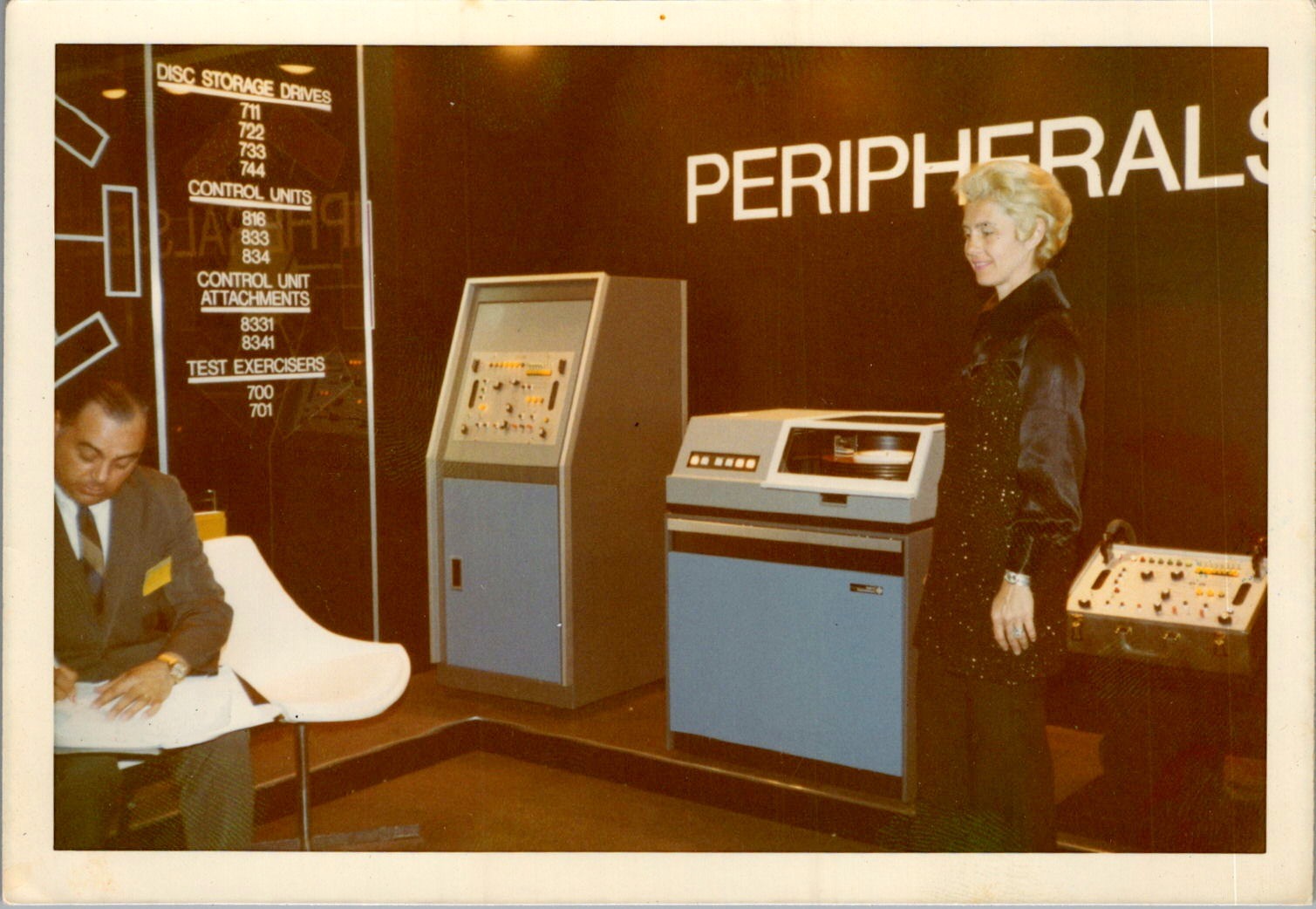
1960s Computer Trade Show Photograph Mainframe Disc Drives Promo Display:
$11.99
This silver gelatin print documents a promotional display at what appears to be a computer technology exhibition or trade show, likely dating to the late 1960s or early 1970s. A large printed sign in the background announces "PERIPHERALS," with a left-hand column listing "DISC STORAGE DRIVES" and the model numbers 711, 722, and 733—catalog designations characteristic of early mainframe peripheral hardware. Two individuals, a man and a woman, stand beside the equipment, their attire reflecting the professional dress conventions of the era: conservative suits and modest hemlines that situate the scene squarely within the corporate culture of midcentury American computing. The woman appears to be demonstrating or presenting a piece of hardware to the man, a common tableau in trade-show photography designed to humanize technical products for promotional or press purposes.The image carries the visual hallmarks of institutional or corporate documentary photography, with even flash illumination and a straightforward, functional composition typical of publicity stills from the period. The equipment itself—likely magnetic disc storage units—represents the era of room-sized mainframes and the nascent data-storage industry, a subject of considerable interest to collectors of computing history and midcentury industrial ephemera. The signage typography, with its clean sans-serif lettering and hierarchical layout, reflects the graphic design conventions of American corporate exhibitions during the late 1960s and early 1970s. Scenes such as this are valuable primary documents for historians of technology, capturing not only the hardware of early computing but also the gendered dynamics of the workplace and the visual rhetoric of American industrial promotion during the mainframe era.

Popular
- 7100 Series
- 7200 Series
- 7700 Series
- 8100 Series
- 8300 Series
- 8700 Series
- 8800 Series
- 8900 Series
- 9000 Series
- 9500 Series
- 9800 Series
- Additional BlackBerry FAQ's
- Applications and Operating System
- Audio and Video
- BlackBerry Information
- Bluetooth
- Do It Yourself DIY
- General BlackBerry Device FAQ's
- Internet and Email (BIS/BES)
- Linux and BlackBerry
- Mac and BlackBerry
- Media Card and General Media FAQ's
- Priv
- Resources
- Wifi / UMA
Recent Posts
- What does the Blackberry PRIV infra-red camera do?
- Is your BlackBerry Nuked?
- Painting DIY
- Got Your BlackBerry Wet?
- How can I retrieve a deleted Phone Number?
- Voicemail with Voice-to-Text Automatic Transfer
- Develop Software for BlackBerry
- Faxes To & From BlackBerry
- BlackBerry For Deaf & Hard of Hearing
- StandyBy mode vs. Sleep
- Buying a BlackBerry off eBay
- Types of BB Batteries
- Maximum Battery Life
- Tips and Tricks
- International BlackBerry Compatibility Guide
- RIM Vendor Codes
- BlackBerry Connect
- BlackBerry News Sites
- BlackBerry Hardware FAQ
- BlackBerry Database Details